
In Hindi:
The possibility of a universal minimum pension scheme has been a highly anticipated topic for millions of citizens seeking financial security in their later years. However, if you have been waiting for the government to announce a fixed, guaranteed pension for every Indian, the latest updates from the July 2026 Parliament session provide a definitive reality check.
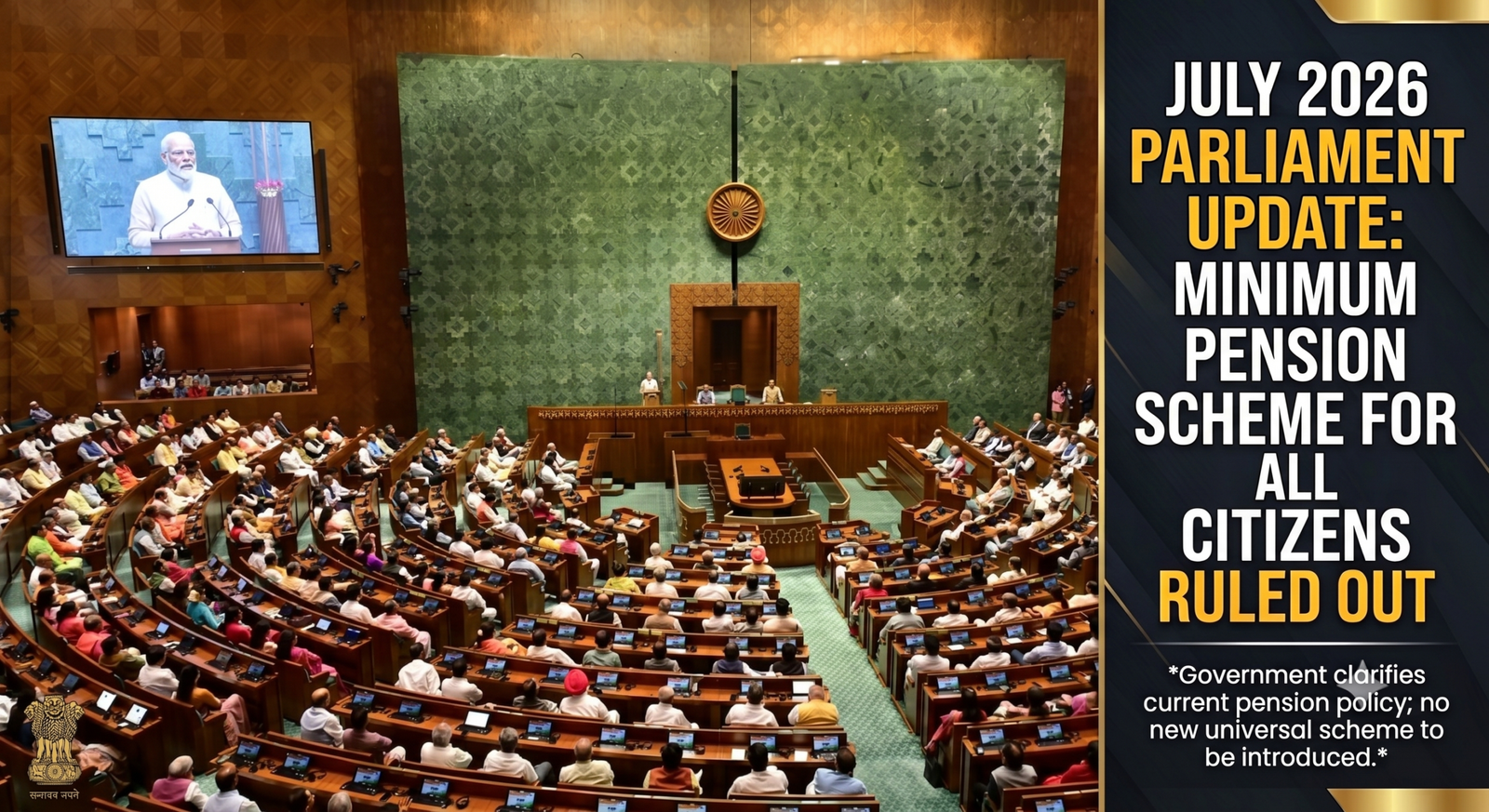
Responding to demands and queries during the recent monsoon session, the Ministry of Labour and Employment officially clarified that there are currently no plans to launch a minimum pension scheme for all citizens.
Here is a breakdown of what the government actually said, why this matters, and how you can still secure your retirement through existing avenues.
The Parliament Clarification: What Was Said?
The clarification came in response to a question raised in the Rajya Sabha by MP R. Girirajan, who inquired if the government intended to provide financial support to elderly citizens, including aged and destitute women, through a new universal scheme.
Minister of State for Labour and Employment Shobha Karandlaje stated clearly in a written reply that there is no proposal under consideration for a “minimum pension scheme for all”. Rather than creating a single, blanket pension for every citizen, the government is shifting its focus toward strengthening and expanding India’s existing social security frameworks.
Interestingly, the parliamentary reply also highlighted that over ₹9,330 crore was lying unclaimed in inoperative Employees’ Provident Fund (EPF) accounts as of March 31, 2026.
What This Means for Unorganised and Formal Workers
For the masses—including gig workers, domestic helpers, and daily wage earners—this announcement means that financial support in old age will not arrive automatically. You will still need to meet the specific eligibility criteria of existing schemes.
The government underscored its commitment to the Code on Social Security, 2020. This code focuses on bringing unorganised, gig, and platform workers under a structured welfare net. To benefit, workers must actively register on government databases like the e-Shram portal, which already hosts over 31.78 crore unorganised workers as of mid-July 2026.
Existing Alternatives for Retirement Security
While a universal minimum pension is off the table, you still have several viable avenues to build your retirement corpus:
Employees’ Pension Scheme (EPS-95/2026): For formal sector employees contributing to the EPF, this remains the primary route for pension benefits. Though pensioner groups have long demanded raising the minimum EPS payout to ₹7,500, it currently remains at ₹1,000 per month until officially revised.
Pradhan Mantri Shram Yogi Maan-dhan (PM-SYM): A voluntary and contributory pension scheme specifically tailored for unorganised workers, offering a guaranteed minimum pension of ₹3,000 per month after age 60.
Atal Pension Yojana (APY): Open to all bank account holders, this scheme allows you to secure a guaranteed monthly pension ranging from ₹1,000 to ₹5,000, depending on your contribution levels.
The Bottom Line
The July 2026 parliamentary clarification puts an end to the speculation surrounding a universal minimum pension. The government’s strategy is clear: rather than rolling out a one-size-fits-all pension, it will rely on targeted, contribution-based systems and active worker registrations.
Now, more than ever, the responsibility of retirement planning rests on proactive saving. Whether it is ensuring your EPF accounts are active, registering on the e-Shram portal, or investing in voluntary schemes like APY, taking action today is the only guaranteed way to secure your financial tomorrow.
In Hindi:
अपने बुढ़ापे में वित्तीय सुरक्षा चाहने वाले लाखों नागरिकों के लिए एक सार्वभौमिक न्यूनतम पेंशन योजना (universal minimum pension scheme) की संभावना लंबे समय से चर्चा का विषय रही है। हालाँकि, यदि आप हर भारतीय के लिए एक निश्चित, गारंटीकृत पेंशन की घोषणा का इंतज़ार कर रहे हैं, तो जुलाई 2026 के संसद सत्र के नवीनतम अपडेट एक स्पष्ट वास्तविकता पेश करते हैं।
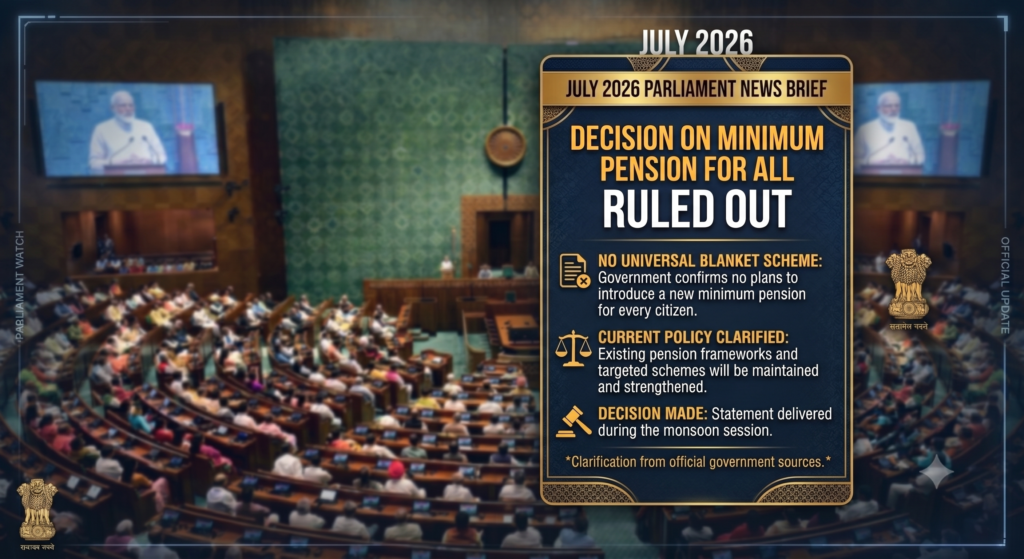
हाल ही के मानसून सत्र के दौरान मांगों और सवालों का जवाब देते हुए, श्रम और रोजगार मंत्रालय ने आधिकारिक तौर पर स्पष्ट किया है कि वर्तमान में सभी नागरिकों के लिए न्यूनतम पेंशन योजना शुरू करने की कोई योजना नहीं है।
यहाँ विस्तार से बताया गया है कि सरकार ने वास्तव में क्या कहा, यह क्यों मायने रखता है, और आप अभी भी मौजूदा विकल्पों के माध्यम से अपने रिटायरमेंट (सेवानिवृत्ति) को कैसे सुरक्षित कर सकते हैं।
संसद का स्पष्टीकरण: क्या कहा गया?
यह स्पष्टीकरण राज्यसभा में सांसद आर. गिरिराजन् द्वारा उठाए गए एक सवाल के जवाब में आया, जिन्होंने पूछा था कि क्या सरकार का किसी नई सार्वभौमिक योजना के माध्यम से बुजुर्ग नागरिकों, जिनमें वृद्ध और बेसहारा महिलाएं भी शामिल हैं, को वित्तीय सहायता प्रदान करने का कोई इरादा है।
श्रम और रोजगार राज्य मंत्री शोभा करंदलाजे ने एक लिखित उत्तर में स्पष्ट रूप से कहा कि “सभी के लिए न्यूनतम पेंशन योजना” पर कोई प्रस्ताव विचाराधीन नहीं है। हर नागरिक के लिए एक समान पेंशन बनाने के बजाय, सरकार भारत के मौजूदा सामाजिक सुरक्षा ढांचे को मजबूत करने और उसका विस्तार करने पर ध्यान केंद्रित कर रही है।
दिलचस्प बात यह है कि संसदीय जवाब में इस बात पर भी प्रकाश डाला गया कि 31 मार्च, 2026 तक निष्क्रिय कर्मचारी भविष्य निधि (EPF) खातों में ₹9,330 करोड़ से अधिक की राशि बिना दावे (unclaimed) के पड़ी थी।
असंगठित और औपचारिक क्षेत्र के कर्मचारियों के लिए इसका क्या मतलब है?
आम जनता के लिए—जिनमें गिग वर्कर्स, घरेलू कामगार और दिहाड़ी मजदूर शामिल हैं—इस घोषणा का मतलब है कि बुढ़ापे में वित्तीय सहायता अपने आप नहीं मिलेगी। आपको अभी भी मौजूदा योजनाओं की विशिष्ट पात्रता मानदंडों को पूरा करना होगा।
सरकार ने सामाजिक सुरक्षा संहिता, 2020 (Code on Social Security, 2020) के प्रति अपनी प्रतिबद्धता को रेखांकित किया। यह संहिता असंगठित, गिग और प्लेटफॉर्म वर्कर्स को एक संरचित कल्याणकारी जाल के तहत लाने पर केंद्रित है। लाभ उठाने के लिए, श्रमिकों को ई-श्रम (e-Shram) पोर्टल जैसे सरकारी डेटाबेस पर सक्रिय रूप से पंजीकरण करना होगा, जिस पर जुलाई 2026 के मध्य तक पहले ही 31.78 करोड़ से अधिक असंगठित श्रमिक पंजीकृत हैं।
रिटायरमेंट सुरक्षा के लिए मौजूद विकल्प
भले ही सभी के लिए न्यूनतम पेंशन योजना फिलहाल संभव नहीं है, फिर भी आपके पास अपने रिटायरमेंट फंड को बनाने के कई बेहतरीन विकल्प मौजूद हैं:
कर्मचारी पेंशन योजना (EPS-95/2026): EPF में योगदान करने वाले औपचारिक क्षेत्र के कर्मचारियों के लिए, यह पेंशन लाभ का प्राथमिक साधन बना हुआ है। हालाँकि पेंशनभोगी समूह लंबे समय से न्यूनतम EPS भुगतान को बढ़ाकर ₹7,500 करने की मांग कर रहे हैं, लेकिन आधिकारिक तौर पर संशोधित होने तक यह वर्तमान में ₹1,000 प्रति माह ही है।
प्रधानमंत्री श्रम योगी मान-धन (PM-SYM): असंगठित क्षेत्र के श्रमिकों के लिए विशेष रूप से बनाई गई यह एक स्वैच्छिक और अंशदायी पेंशन योजना है, जो 60 वर्ष की आयु के बाद ₹3,000 प्रति माह की गारंटीकृत न्यूनतम पेंशन प्रदान करती है।
अटल पेंशन योजना (APY): सभी बैंक खाताधारकों के लिए खुली यह योजना आपको आपके योगदान के स्तर के आधार पर ₹1,000 से ₹5,000 तक की गारंटीकृत मासिक पेंशन सुरक्षित करने की अनुमति देती है।
निष्कर्ष
जुलाई 2026 के संसदीय स्पष्टीकरण ने सार्वभौमिक न्यूनतम पेंशन से जुड़ी सभी अटकलों पर विराम लगा दिया है। सरकार की रणनीति स्पष्ट है: सभी के लिए एक जैसी पेंशन योजना लागू करने के बजाय, वह लक्षित, योगदान-आधारित प्रणालियों और सक्रिय श्रमिक पंजीकरण पर निर्भर रहेगी।
अब, पहले से कहीं अधिक, रिटायरमेंट प्लानिंग की जिम्मेदारी आपकी सक्रिय बचत पर निर्भर करती है। चाहे आपके EPF खातों को सक्रिय रखना हो, ई-श्रम पोर्टल पर पंजीकरण करना हो, या APY जैसी स्वैच्छिक योजनाओं में निवेश करना हो, आज कदम उठाना ही आपके वित्तीय भविष्य को सुरक्षित करने का एकमात्र गारंटीकृत तरीका है।