
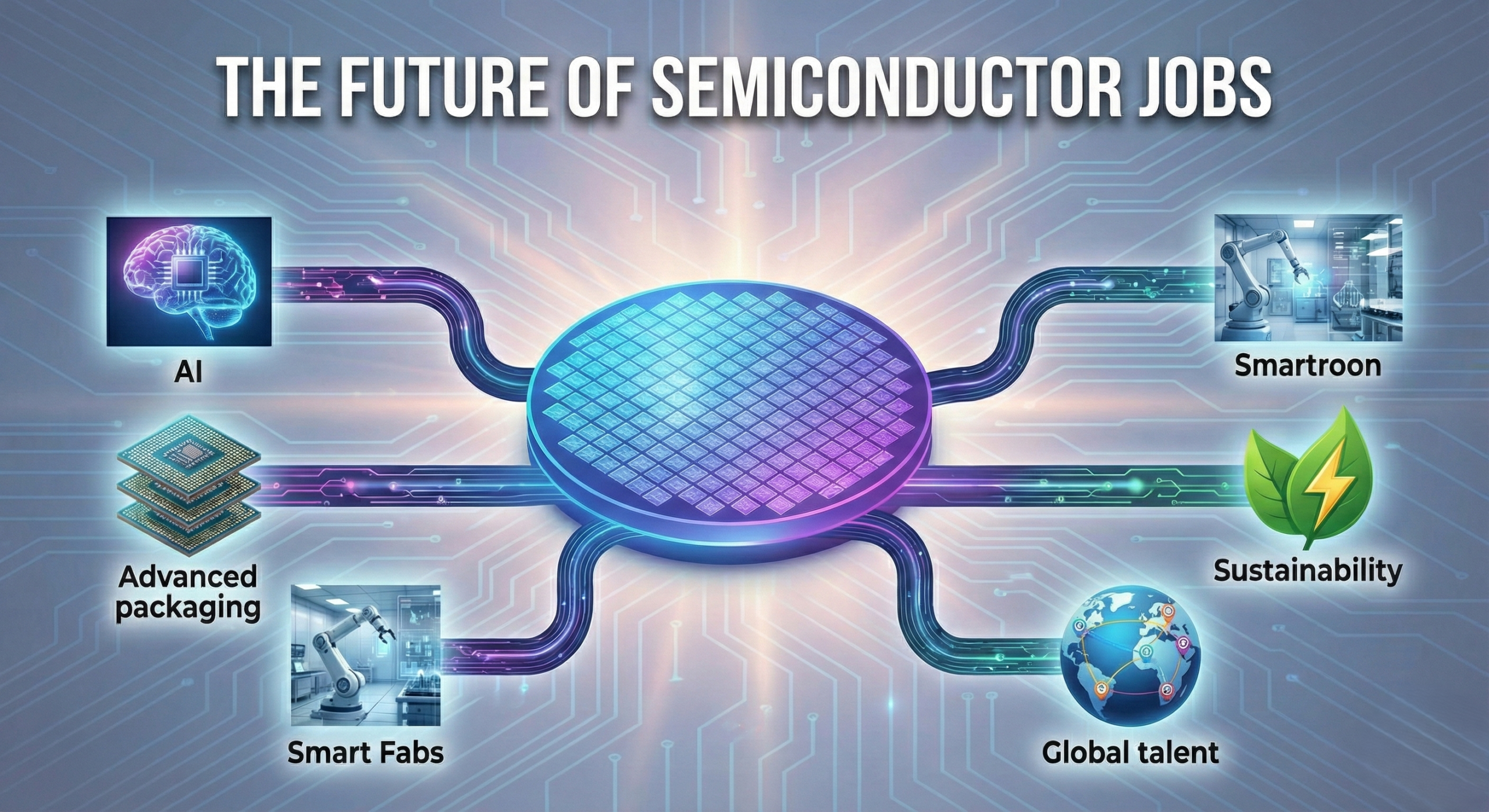
आज की दुनिया सिर्फ सॉफ्टवेयर पर नहीं, बल्कि उन ‘चिप्स’ पर चलती है जो इस सॉफ्टवेयर को मुमकिन बनाते हैं। आपके स्मार्टफोन में मौजूद AI से लेकर इलेक्ट्रिक वाहनों के एडवांस सेंसर्स तक, सेमीकंडक्टर्स आधुनिक तकनीक के गुमनाम नायक हैं।
ग्लोबल इन्वेस्टमेंट्स और भारत के ‘इंडिया सेमीकंडक्टर मिशन 2.0’ जैसे कदमों ने देश को डिजाइन और मैन्युफैक्चरिंग का एक बड़ा केंद्र बना दिया है। अगर आप एक ऐसा करियर चाहते हैं जो भविष्य में कभी फीका न पड़े, तो इन 5 क्षेत्रों पर नजर रखें:
1. चिपलेट आर्किटेक्ट्स (Chiplet Architects): मॉड्युलर डिजाइन के उस्ताद
अब वे दिन गए जब एक ही बड़ा चिप सारा काम करता था। भविष्य ‘चिपलेट्स’ का है—यानी छोटे, विशेष फंक्शन वाले ब्लॉक्स जिन्हें एक साथ जोड़कर एक शक्तिशाली सिस्टम बनाया जाता है। इसे माइक्रोचिप्स के लिए ‘लेगो (Lego)’ गेम की तरह समझें!
-
यह क्यों ट्रेंड में है: यह तरीका कंपनियों को तेजी से इनोवेशन करने और लागत कम करने में मदद करता है।
-
करियर की राह: अगर आपको सिस्टम-लेवल थिंकिंग और बारीकियों में महारत हासिल है, तो यह फील्ड आपके लिए है।
2. स्मार्ट मैन्युफैक्चरिंग के लिए AI और ML
एक सेमीकंडक्टर बनाना दुनिया की सबसे जटिल प्रक्रियाओं में से एक है। अब ‘फैब्स’ (Fabs) यानी चिप बनाने वाली फैक्ट्रियों में आर्टिफिशियल इंटेलिजेंस (AI) और मशीन लर्निंग (ML) का इस्तेमाल उत्पादन को बेहतर बनाने के लिए किया जा रहा है।
-
यह क्यों ट्रेंड में है: मशीनों की खराबी का पहले से पता लगाने (Predictive Maintenance) से लेकर बारीकी से कमियां ढूंढने तक, AI हर काम को स्मार्ट बना रहा है।
-
करियर की राह: डेटा साइंटिस्ट और ऑटोमेशन एक्सपर्ट्स, जिन्हें मैन्युफैक्चरिंग की समझ है, उनकी मांग सबसे ज्यादा है।

3. एडवांस पैकेजिंग और हेटेरोजेनियस इंटीग्रेशन (Heterogeneous Integration)
जैसे-जैसे ट्रांजिस्टर को और छोटा करना मुश्किल हो रहा है, इंजीनियर अब चिप्स को एक-दूसरे के ऊपर (3D स्टैकिंग) या साथ-साथ जोड़ने पर ध्यान दे रहे हैं।
-
यह क्यों ट्रेंड में है: यह कम बिजली की खपत में हाई-परफॉर्मेंस पाने का सबसे अच्छा तरीका है।
-
करियर की राह: यह फील्ड मैटेरियल साइंस और इलेक्ट्रिकल इंजीनियरिंग का एक अनोखा मिश्रण है।
4. एज एआई (Edge AI) के लिए डिजाइन इंजीनियर्स
हर छोटी डिवाइस को डेटा प्रोसेस करने के लिए क्लाउड सर्वर पर निर्भर रहना संभव नहीं है। इसलिए अब ‘एज एआई’ का दौर है, जहाँ डेटा वहीं प्रोसेस होता है जहाँ वह पैदा होता है—जैसे स्मार्ट कैमरा या सेल्फ-ड्राइविंग कार के अंदर।
-
यह क्यों ट्रेंड में है: कम बिजली खपत वाले और बेहद कुशल AI एक्सेलेरेटर चिप्स की भारी मांग है। भारत में RISC-V जैसे ओपन-सोर्स आर्किटेक्चर पर काम इसे और बढ़ावा दे रहा है।
-
करियर की राह: हार्डवेयर और सॉफ्टवेयर को एक साथ जोड़कर नए डिजाइन बनाने वाले इंजीनियर्स के लिए यहाँ असीम संभावनाएं हैं।
5. क्वांटम कंप्यूटिंग हार्डवेयर इंजीनियर्स: अगली क्रांति
क्वांटम कंप्यूटिंग अभी शुरुआती दौर में है, लेकिन यह प्रोसेसिंग पावर की अगली बड़ी छलांग है। इसे हकीकत बनाने के लिए एडवांस फिजिक्स और इंजीनियरिंग की जरूरत है।
-
यह क्यों ट्रेंड में है: इसके लिए क्वांटम मैकेनिक्स और क्रायोजेनिक्स (अत्यधिक ठंड) जैसी विशेषज्ञता की आवश्यकता होती है।
-
करियर की राह: जो लोग अभी इस क्षेत्र में कदम रखेंगे, वे भविष्य की सबसे क्रांतिकारी तकनीक के लीडर बनेंगे।
क्या आप तैयार हैं?
सेमीकंडक्टर इंडस्ट्री सिर्फ पुर्जे नहीं बना रही, बल्कि भविष्य का निर्माण कर रही है। भारत में हो रहे बड़े निवेश के साथ, इस रोमांचक सफर का हिस्सा बनने का इससे बेहतर समय नहीं हो सकता।

Future-Proof Your Career: 5 Hot Job Trends in the
Semiconductor Industry
The world runs on semiconductors, and the industry is exploding! From the AI in your smartphone to the advanced sensors in electric vehicles, chips are the unsung heroes of modern tech. For ambitious professionals, this isn’t just a trend—it’s a massive wave of opportunity.
India, in particular, is making monumental strides with initiatives like the India Semiconductor Mission 2.0, aiming to become a global hub for design and manufacturing. If you’re looking to jump into a future-proof career, now’s the time.
Here are the top 5 job trends that will define the semiconductor industry in the coming years:
1. The Rise of “Chiplet” Architects: Masters of Modular Design
Gone are the days when a single, monolithic chip did it all. The future is about chiplets – smaller, specialized functional blocks that are integrated into a single package. Think of it like Lego for microchips!
Why it’s hot: This modular approach allows for greater customization, faster innovation, and better yield. Companies need experts who can design these individual chiplets and, more importantly, figure out how to seamlessly integrate them. If you love system-level thinking and pushing the boundaries of miniaturization, this is your calling.
2. AI & ML for “Smart” Chip Manufacturing: The Automation Revolution
Manufacturing a semiconductor is one of the most complex processes known to humanity, involving hundreds of steps in ultra-clean environments. Artificial Intelligence and Machine Learning are no longer just for software; they are becoming critical for optimizing every stage of chip production.
Why it’s hot: From predictive maintenance on multi-million dollar machinery to real-time defect detection using computer vision, AI is making fabs smarter and more efficient. Data scientists, machine learning engineers, and automation specialists with a deep understanding of manufacturing processes will be invaluable.
3. Advanced Packaging & Heterogeneous Integration Specialists
As traditional transistor scaling slows down, the magic is increasingly happening above and around the chip. Advanced packaging involves stacking multiple dies (chiplets) vertically or side-by-side in a 3D configuration to create powerful, compact systems.
Why it’s hot: This field is crucial for achieving higher performance and lower power consumption. Engineers specializing in heterogeneous integration – combining different types of chips (e.g., logic, memory, sensors) in a single package – are in high demand. It’s a blend of materials science, electrical engineering, and mechanical precision.
4. Design Engineers for Specialized AI Accelerators (Edge AI Focus)
The demand for AI is ubiquitous, but running complex AI models on massive cloud servers isn’t always practical or energy-efficient. This is where Edge AI comes in – bringing AI processing closer to the data source, like in smart cameras, IoT devices, or autonomous vehicles.
Why it’s hot: This creates a massive need for design engineers who can create highly specialized, power-efficient AI accelerators. These chips are optimized for specific AI tasks, requiring expertise in neural network architectures, low-power design, and hardware-software co-design. India’s focus on homegrown IP, especially with RISC-V, is fueling this area.
5. Quantum Computing Hardware Engineers: Pioneering the Next Frontier
While still in its nascent stages, quantum computing is undeniably the next great leap in processing power. The development of quantum computers relies heavily on groundbreaking semiconductor physics and engineering.
Why it’s hot: Building and maintaining these quantum systems requires a highly specialized skill set at the intersection of quantum mechanics, cryogenics, and advanced electronics. While it’s a long-term play, those who get in early will be at the forefront of a technological revolution. This involves designing exotic materials and architectures for qubits, error correction, and control systems.
The semiconductor industry is not just building components; it’s building the future. With rapid innovation and significant investments, especially here in India, there’s never been a more exciting time to be part of this dynamic field. Are you ready to chip in?